Home
CNJ
CNJ Books
Steam... [3 photo tables]
Diesels... [table/paint sch.]
CNJ Links
CNJ Models in HO
Steam Models Table
Steam Model Photos...
Diesel Models Table
Diesel Model Photos...
Loco. Kitbashes
Mauch Chunk
Buildings...  [plans]
Railroad...
Photos...
Plans & Maps
Books & Links
Our Model
Progress...
Projects...
Track Plan
Articles
The Modellers...
Site Map
Thanks
New on the site
Contact Us
 

Steam Table Steam Photos Diesel Table Diesel Photos Kitbashes Stock Photos
Kitbashes >  [see below for B6s, E2, G3s and M2/M3]
& Superdetailing [see below for RS3/RSD4-5]

B6s   0-6-0 (standard cab) Switcher kitbash - by Alan Mende
There is an a
rticle in Railroad Model Craftsman, November, 1999 by Alan Mende which describes, with photos, how to kitbash a B6s prototype from a commercial USRA 0-6-0 model.

Photos of Doug Hunt's converted 0-6-0:

back to top

horizontal rule

E2   0-8-0 (wooten cab) Switcher kitbash - by Robert McGlone
This is a commercial USRA 0-8-0 model, kitbashed by Robert McGlone with a commercial Lee Town kit, to approximate an E2 switcher.

Photos of Robert McGlone 's converted 0-8-0:

back to top

horizontal rule

G3s/P47   4-6-2 (standard cab) Pacific kitbash - by Doug Hunt

A rough list for an inexpensive conversion for a CNJ P-47

1) start by getting a Mantua 4-6-2.
2) grind off all the wrong details, but leave the covered turret, the
long air tank on the fireman's side, and steam dome.  Try to grind/file off the sanding valve covers, but leave the sand box.  Better yet, remove the entire thing, and transplant an IHC 4-6-2 sand box.  Move it closer to the stack like CNJ's.

Okay, now here's a parts list.  They should cost around $65 by my math, plus shipping and handling.  Everything comes from Bowser, so you don't have to pay shipping several times from different mfgrs.  Also, an important note:  This is a very subjective list.  Many of the "detail" parts are not the type of detail that some of you may insist on.  However, concessions were made to keep the cost down and show that you CAN do this without spending a fortune.  If you want to go all PSC, Cal-Scale, and Cary, then fine, your model would look that much better for it, but triple the cost of the detail parts.  Some of the parts are Selley Finishing Touches, they are spin-cast metal, and much less expensive than lost-wax brass castings.  The Selley parts have a nice level of detail to them.

bullet

bell 1-740, $2.25

bullet

headlight 1-91016, $1.95

bullet

light bracket 190-241, $2.65

bullet

Elesco FWH, 675-379, $1.65

bullet

Elesco pump, 675-376, $1.65

bullet

air compressor, 675-506, $3.30 (2@ $1.65 ea)

bullet

air tank, 1-70066, $0.75

bullet

power reverse, 1-70047, $0.80

bullet

generator, 675-401, $1.65

bullet

whistle, 1-9231, $0.50 (not a very detailed part, but a durable brass

bullet

turning.  Selley has whistles, but they will break!)

bullet

pop valves 1-1857, $1.50 (2@ $0.75 ea)

bullet

train control box, 1-70063, $0.75

bullet

check valves pair, 675-370, $1.65

bullet

tender trucks, USRA, 1-2990, $9.95 (best approximation for CNJ trucks.  Life Like or Model Power makes an F-7 with undersize Blomberg trucks, hmmm)

bullet

80" spoke driver, light, no bearings, 1-16000, $16.00 (2@ $8.00)

bullet

80" spoke driver, heavy, Mantua gear, 1-16042, $9.00

bullet

hand rail posts 10pcs, 1-6000, $5.50 (2@ $2.25)

You need a different cab.  If you can get an IHC pacific boiler, then you have a sand box and cab you can modify for CNJ use.  Pro-Custom Hobbies in Maryland, has a small quantity of etched brass USRA cabs that you could use for the CNJ pacific.  I bought one for $10 to use on a B&O P-7.

Mantua used to have less expensive drivers than Bowser.  However, getting everything from the same supplier means you only pay P&S once.  I don't know what MDC or Mantua has by way of inexpensive detail parts.  If you want to save some money, you could You can always scour the parts catalogs and buy more parts, and make a nicer-looking engine.  It will cost more.  I would suggest getting a NWSL quarterer so that you can install a NWSL gearbox and high- quality can motor.   Those 3 things will run you under $100, and are worth the investment.

bullet

Mantua pacific...$30 or so on ebay

bullet

Parts...$65 or so

bullet

Cab...$10

Have fun! back to top

horizontal rule

M2 & M3 2-8-2 (standard cab, wooten firebox) Mikado Kitbash - by Victor Roseman

Wooten Fireboxes and other details for CNJ M2 & M3 Mikados

For Mikados the Rivarossi engine is a good start. The Mikes were always the best running of this line of engines. Shame to remotor them. I think the newest ones come with a better motor and small flanges. As they come they are nothing. They have the Pacific boiler which has too small a smoke box. I cut the stack off and filed down the details and wrapped the smokebox in about .020 or so thick styrene sheet, you could probably get Riko or else our Evergreen.

Then the fun starts for there is no boiler front for this. I wrapped a brass casting with about .030 square section strip styrene- brass would be better but it is what I had. Makes a credible front end, although you could file off what you don't need on the Rivarossi front and wrap that for a beefy looking front. Details varied from loco to loco and you have to pick out what you need from catalogs, unfortunately. To have a real USRA Mike you need a Cole trailing truck. I think I chopped mine down from the Rivarossi Delta truck, but you could use the one of the Mehano Pacific or Mikado as well, or use those as a starting point to build your own.

I suggest getting the catalog from Bowser for Cal Scale parts, including a lot of Bowser and Cary pieces you might be able to cobble into something too. Precision Scale catalog has many times more of what they make than you would find in Walthers, if you have one of those catalogs.

For the fireboxes on these engines, Lee Town had nothing you could use unless you could make something for a 2-8-0 fit. I added strip styrene to the outside of the plastic boilers and wrapped these with sheet to get the wide firebox. The cab gets notched too and the front and bottom plates glued to the open area- make those from bits of styrene sheet. This is not hard to do if you have worked in styrene before. If not, make up some cubes and little forms as practice before chopping into a Rivarossi model.

Personally, I work from a Rivarossi boiler as described above and use the Mantua mechanism with Bowser spoked drivers. I gear my locos with the NWSL spares and sets and I use a Mashima motor, although your favorite will do too. I fit together valve gear using the very nice little link Bowser offers for (I think) their K-4., but you can retain the whole Mantua valve gear for it is pretty close to CNJ's

M2 & M3 2-8-2 (standard cab, wooten firebox) Mikado Kitbash cont..    - by Doug Hunt

  1. notch cab

  2. widen firebox, build up with styrene.  New running boards over the new firebox sides.

  3. possibly relocate generator to fireman's side of firebox

  4. enclosed turret in front of cab, maybe Bowser's IC covered turret

  5. twin single stage air compressors

  6. optional: Elesco feedwater heater system

  7. trailing truck is fine as-is for an M-2/M-3

  8. the IHC 4-6-2 trailing truck or Bowser's USRA 4-6-2 die-cast trailing truck is good for an M-1.  Cal-scale also has a brass one, but it is very expensinve, and the Bowser die-cast is the same thing.  (Bowser owns the Cal-scale line)

  9. different vertical boiler check valves, Precision Scale makes a nice set

  10. smokebox modification Vic described.  A Cal-Scale 81" USRA front would be a good starting point.

back to top


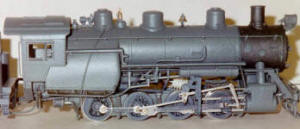
M2as 2-8-2 (standard cab, wooten firebox) Mikado Kitbash from BLI M1    - by Doug Hunt
Photos showing modifications:


Photos of M2as after painting:
      
back to top


RS3 / RSD4-5
- by Nick Salerno

Photo of RS3 after painting:

As with any job, it's important to have the right tools. So first, here is a list of the tools
you'll need:

Exacto knife with #11 and #17 blades
Micro-Mark Flexpad 320 grit or similar
Pin vise or finger drill with #58 drill bit
Flat head screwdriver 5/64"
Phillips screwdriver #0
Fine tip paint brush with wood handle (you'll see why later)
Cyanoacrylate Adhesive (CA)
Scotch Tape

And now a list of necessary parts and materials:

Pollyscale, "C&O Enchantment Blue"
Pollyscale, "Rust"
Pollyscale, "Concrete"
Pollyscale, "Earth"
Pollyscale, "Grimy Black"
Bethlehem Car Works RS3 Marker Lights, part #31 4pk.
Roundhouse Products #'s 2961 (red). 2962 (green) Marker Lamp Jewels
or MV Lenses (not sure of part #)
Evergreen Scale Models strip styrene #222, 1/16" rod
Kadee #5 couplers (Optional)
Details West AH-174 "Wabco" Single Chime Air Horn
Details West MU-266 MU Hose 3 cluster set
This is optional, but I feel is TOTALLY NECESSARY:
Spare RS3 shell to use as a mock-up to test fit parts BEFORE you scour or drill out your
prized model!!

I'll assume the reader is unfamiliar with the anatomy of an Atlas RS3, so some may find my
instructions a little wordy. I'm sorry in advance. Now let's get started!

Step 1a: Dissection

First, we'll remove the handrails. It's not necessary to remove the end handrails above the
pilots, so we'll leave them alone. Carefully pull ends of rails out of the cab and gently pull
rail stanchions up from steps leading to cab (both can be done carefully with your fingers).
Then, take 5/64" flathead screwdriver and "pop" handrail stanchions out by inserting
screwdriver tip up from beneath the walkways. Each stanchion has its own small opening
where its base meets the walkways. You risk breaking them if you pull up with your
fingers, so avoid doint that. The ends of the rails where they meet the end steps can be
freed carefully by using the shaft of the screwdriver to pry them away. Use your fingers as
"tweezers" if you need to, but be careful.

Once handrails are off, pinch the sides of the front and rear of the body near the bottom
edge where it meets the walkways and lift to separate it from the chassis. Then, take #0
screwdriver and remove draft gear boxes so the walkways can be removed from the
chassis.

Step 1b: If you are installing a decoder, now is a good time.

Step 2: Removing unneeded details

We'll do the easy one first. Each horn has two supports. We'll call them FRONT (furthest
from the cab) and BACK (nearest to the cab). Take your Exacto knife with a #11 blade and
make a horizontal cut flush with the hood to separate the FRONT of the horn from the
shell. We're going to use the existing hole closest to the cab on BOTH hoods, so try not to
cut the horn completely off. If you're careful, the stem of the horn support will stay in the
FRONT hole to act as a plug. Lift the horn off and discard. Put a spot of glue on the plug
that remained in the FRONT hole to keep it from falling through the bottom. Install new
horns in existing BACK holes using a touch of CA on the underside of the body. We'll paint
them later.

Trim the edges of the MU hose castings and drill a hole for the correct mounting location
on the pilots. They are marked R and L. When in place, paint hoses Grimy Black and apply
silver paint to the ends.

Now this is where I hope you have a spare shell to practice this first. We have to remove
the external "rib" on the right side of the long hood for the oil breather. The CNJ units
didn't have this feature, instead they had a breather tube that didn't exit the hood until it
neared the top. Take the Exacto knife with the #17 blade. This is a chisel tip which you will
use as a planer to shave down the rib until it's flush with the hoodside. I turn the blade so
the bevel is towards the body and work from top to bottom, removing small portions at a
time. It's very possible for it to slip and get buried in your palm. How do I know that? Once
you remove the majority of the rib, you can use the Flexpad to sand out any imperfections.
Just for kicks, I also used the Flexpad to lightly sand the louvers on all the doors to "bring
them out."

We'll make the breather tube out of the 1/16" styrene rod. Use the chisel tip again to cut
the rod to a 1/2" length. Be sure you make a squared edge (it took me a couple tries). You
can use the Flexpad to sand the ends to make them square if you can't get it with the
blade. Height of this breather tube varied from one unit to the next, and some even had a
bend in it to curve around the sloped side of the hood. I chose to take the easy route and
glue the rod directly to the side of the hood. Use the scar where the rib was as a guide. Put
a spot of CA on the shell nearer to the top and place the rod against the shell. Check
photos to see where to align the bottom edge. I used the bottom edge of the upper
louvers, but again, this varied. Hold it in place carefully until the glue sets.

Step 3: Marker Lights

This is another step in which it's important to have an extra shell. We're going to use the
#58 drill to make mounting holes for the marker lights. The hole will be drilled just to the
side of where the hood begins to slope and between the number board and small line cast
in the plastic (one look and you'll know what I mean). The edge of the hole should just
touch the inner edge of that line. Now, the #58 bit is too small for the marker light
mounting pin, but this is good because the hole may need to be reamed in any direction
to get the light's position correct. Once I got the hole correct, I test fitted the light. When I
was happy, I trimmed the excess length of the mounting pin so it was just long enough to
come through the shell. Put a drop of CA on the mounting pin and apply it to the body.
Before the glue sets, it's possible to bend the light slightly to straighten it, but be careful
because they're made of soft metal and you can snap one off. Trust me! When the glue
sets, you can put another drop of CA on the underside just for good measure. Wait until all
four corners are done to do this, then set the shell upside down so the glue won't run
down and turn the shell into part of your workbench. Also, the weight of the body keeps
pressure on the joints until they set.

Step 4: Prep and Paint

It's important that your model is free of grease or oil before you paint. I use Pollyscale
Plastic Prep #546007. Apply with a cotton ball or paper towel generously to shell and
running gear. DO NOT wash off! Instead, allow model to air dry. Break out the C&O
Enchantment blue paint and the fine tipped brush. This color is so close to the actual
color, I did not mix any other colors with it. You may find it a little light, but the
application of a second coat will remedy that. Paint horns, breather, and marker lamps.

Step 5: Jewel lenses

When the paint has dried, we can apply the jewel lenses. They are very small and hard to
handle, but there's a trick to it. Go get that Scotch tape. First, doing one lamp bezel at a
time, place a small drop of CA on one bezel (each lamp has two). Place a single jewel
(colored side down) on a small piece of tape. Use the tape to hold the jewel as you gently
place it over the bezel. The glue should hold the jewel as you take the tape away. Now use
the opposite side of your paint brush (made of wood) to set the jewel in the bezel. The
wood brush handle is not as prone to reacting with the glue as a plastic handle and will
not take the jewel with it when you pull it away. Continue in this fashion, one jewel at a
time.

Step 6a: Weathering

This is the point where you should do your weathering. If you are handy with an airbrush,
you can reach amazing results on your running gear using only four colors: Grimy Black,
Rust, Concrete and Earth (applied in that order). The body roof should get a good coat of
Grimy Black, as well the topsides of the walkways and pilots. Some thinned Grimy Black
can then be brushed onto the radiator and fan grills to darken them. Even in my photos
from a distance, the radiator grills stand out nicely.

Step 6b: If you are installing a decoder in your model and were too excited to begin the
detail work or were too lazy to do it in Step 1b, do it now.

Step 7: Assembly

Place walkways back over chassis and reattach draft gear boxes. Put on surgical gloves, if
you have not had them on this whole time, to protect your model from greasy fingerprints.
Snap body back onto the frame and reattach handrails. Use the 5/64" screwdriver tip to
press stanchion bases back into respective holes.

I will add that my methods and techniques are only my own and that in no way do I feel
they are correct or the preferred way to do things. I hope you all reached the same
pleasing results with your models as I have with my own.

Happy modeling

Nick


Send emailto Steve (details on contact us page) with questions or comments about this web site.
Last modified:  April, 2008