   |
|
|
Glyn's Model > Updated July 2012 with new photos
Glyn finished part of his basement as a 16’ by 26’ dedicated railroad room with adjoining workshop. His layout runs round the sides of the railroad room, with the potential to build a peninsular extension in the future. Since the layout is planned to be permanent, it is designed for American-style operation with multiple stations and many opportunities for switching. Three stations are represented on the layout – Treichlers, Mauch Chunk and White Haven. The models of each town are based on prototype track layouts and structures although each has been simplified to fit the space available.
|
|
 |
A Tour of the Layout
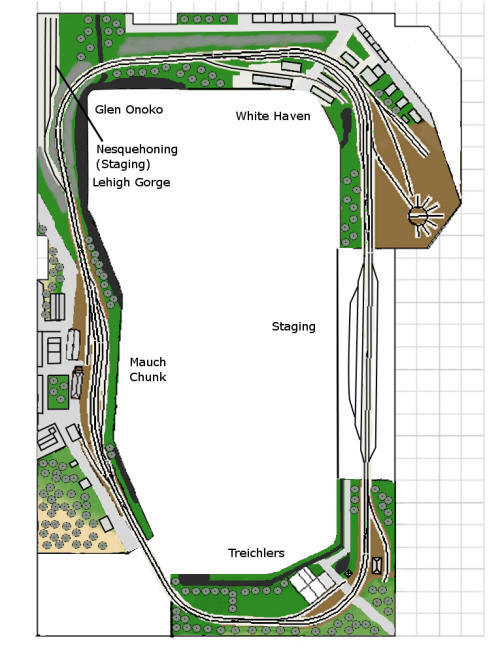
Leaving the storage yard, representing Bethlehem and the east, the train first enters the small town of Treichlers. The real Treichlers is part of Lehigh Township and sits beside a broad stretch of the lower Lehigh valley. The town was a port on the Lehigh Navigation, and canal waters fed a millpond for an early flour mill. The town was also an important bridging point across the Lehigh. During the railroad era, the town was served by the CNJ on the north of the river and the LVR on the south.
Modern Treichlers has changed relatively little. The town is still an important bridging point on the Lehigh, although consecutive rebuilds have moved the bridging site upriver. The main industry in town is still Mauser’s flour mill, and this incorporates the structure of the original 1850’s mill. The mill is rail served from the former CNJ line (the LVR section was eliminated in the 1960’s consolidation of lines). Mill power transitioned from the original underfed water wheel, through water-powered electric turbines, to mains power, and the old mill pond is now largely drained. Only ruins remain of the Lehigh Navigation canal locks. Unfortunately, a recent development has been the replacement of the historic grain silos with a modern structure. The railroad is still in use, but the railroad depot and enclosed water tank have been demolished.
On the layout, the center of the Treichlers scene is a large scratch-built model of Mauser Mill in the 1940’s, including the canal-fed mill pond and turbine race. The model was built from a mix of historic and modern photographs because the look of the mill changed in a rebuild following a fire in 1953.
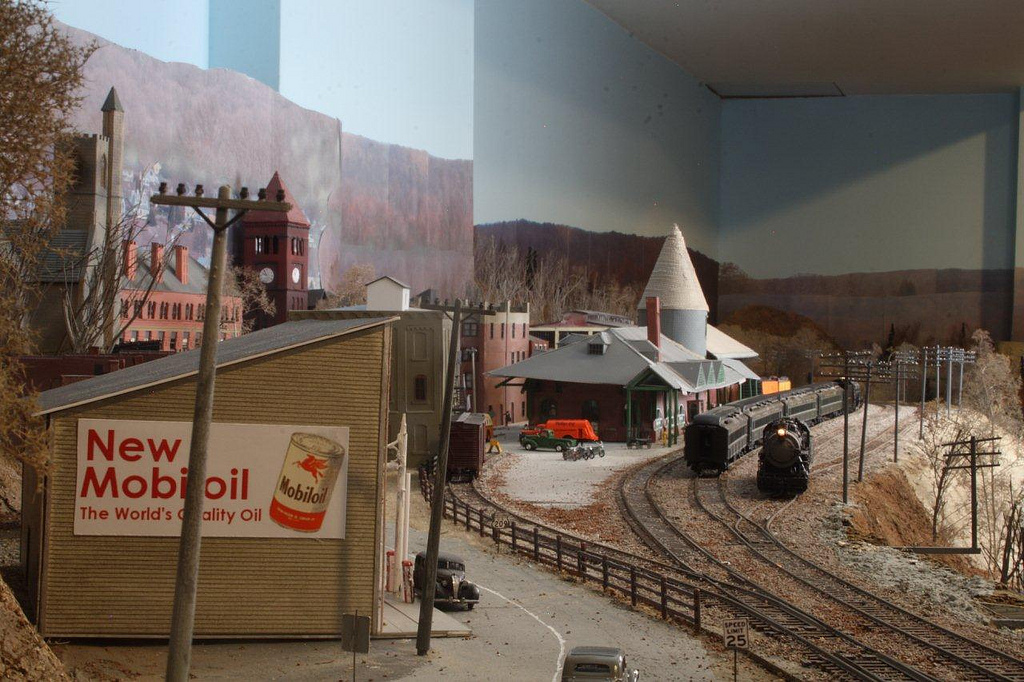
The Treichlers depot is built from an N-Scale Architect craftsman kit for a CNJ standard station, and is typical of CNJ stations in the New Jersey suburban belt. It will eventually be replaced with a model of the real depot.
Although this scene appears to be complete there is plenty of scope to build additional prototypical structures (railroad, road bridge, mill, farming, and canal) in future.
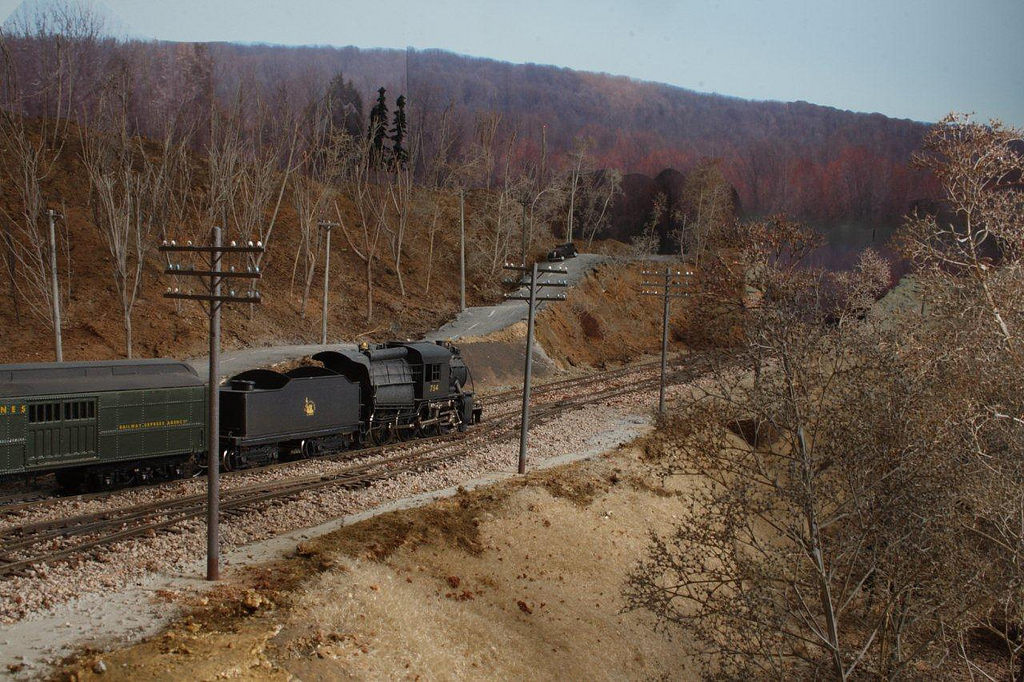
Leaving Treichlers, the train traverses a short section of the Lehigh valley in parallel with the Lehigh Navigation canal and crosses the duck-under across the entrance to the room before entering Mauch Chunk.
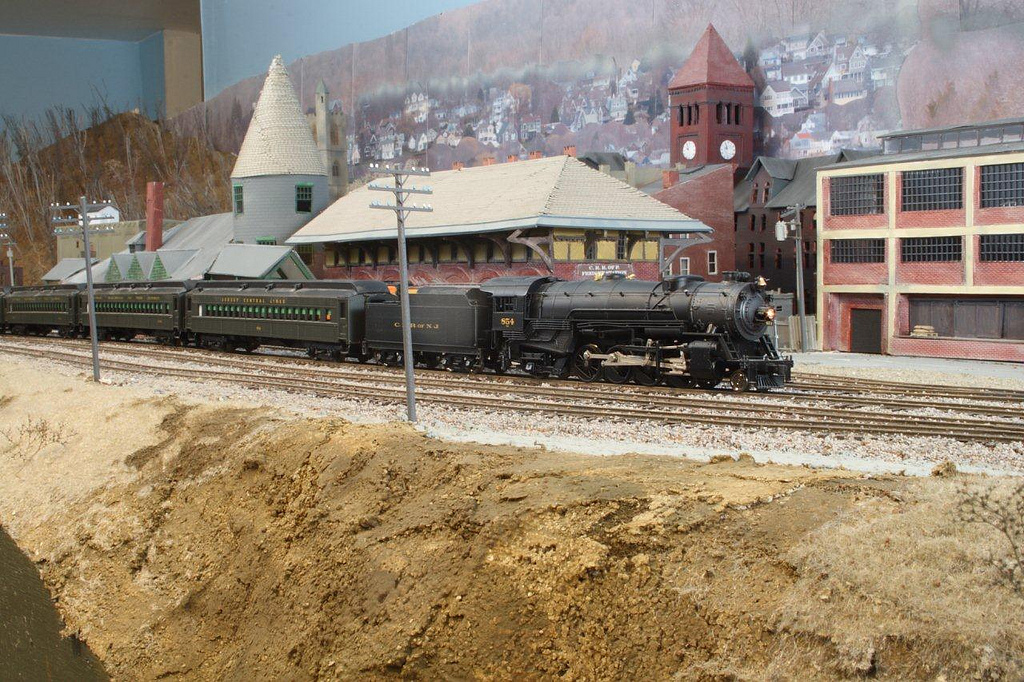
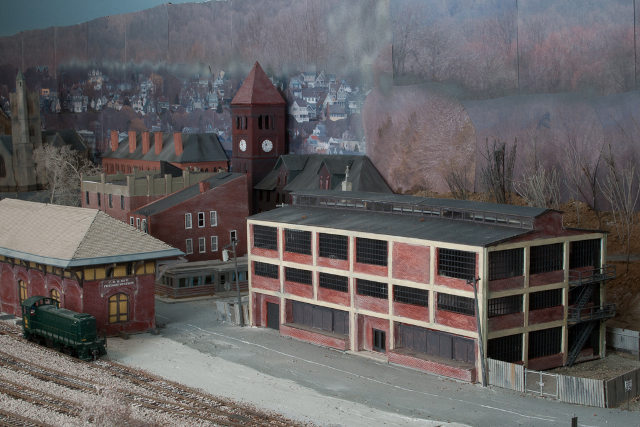
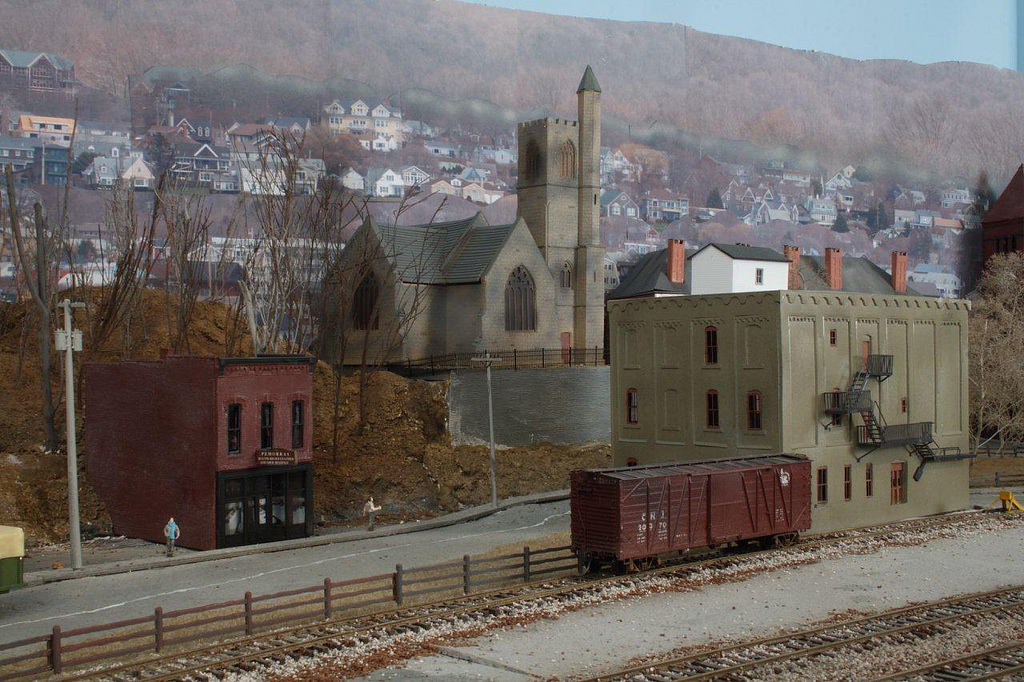
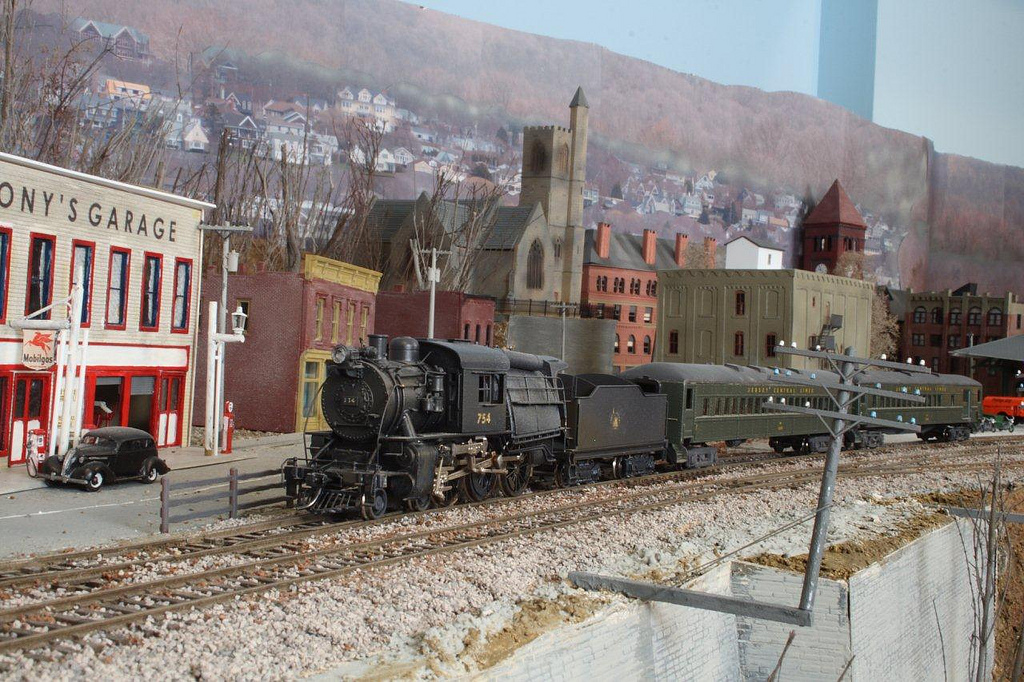
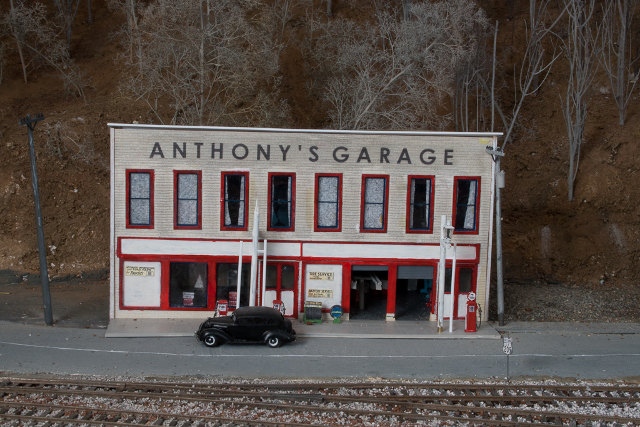
Entering Mauch Chunk, the train passes an abbreviated Susquehanna Street. Anthony’s Garage is fully detailed from a craftsman kit that Glyn designed in Kit-O-Matic. It includes a lit and detailed interior. Other Susquehanna Street shops are represented by Design Preservation Models (DPM) kits.
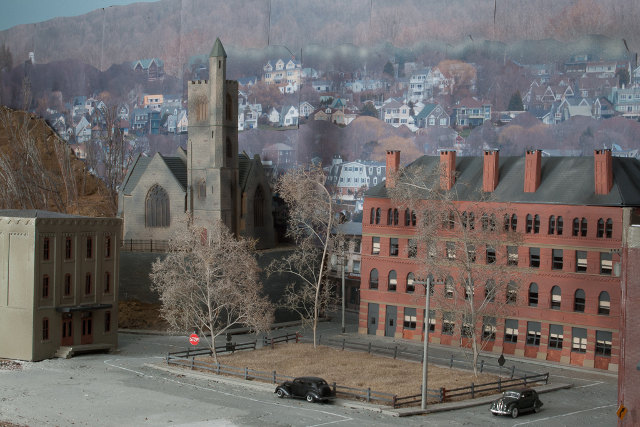
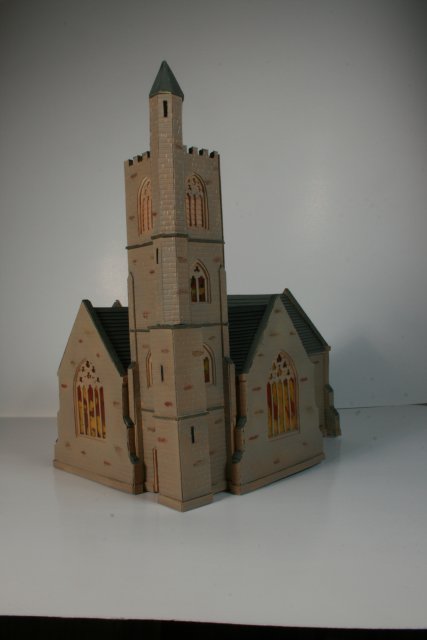
In the town center, most of the signature buildings have been scratch built, including the station, freight house, court house, Navigation Building, Hooven Mercantile, Central Hotel, Switzerland Hotel, the war memorial, and St John’s church. Merseyside diagrams were used for most of these structures. Sunshine (nee Steve’s) Diner would have been new in 1948 and is represented by a modified City Classics kit. The Iron Works is scratch built with windows from a Walthers kit.
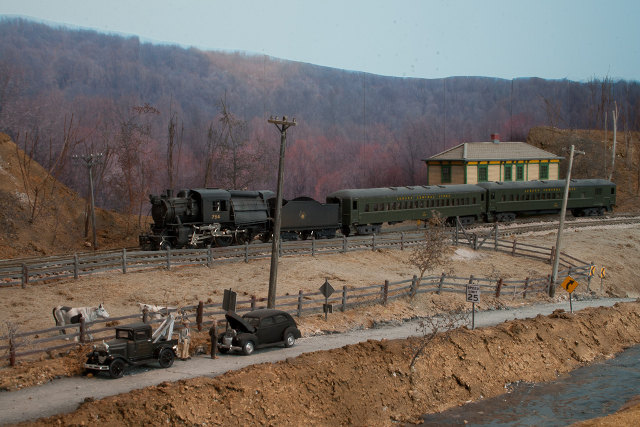
From Mauch Chunk, trains may either use the Nesquehoning branch (direct access to storage), or continue through the Lehigh valley to White Haven. A short section of the valley is represented, reminiscent of Ox Bow Curve, and a bridge crossing a small stream represents the famous Glen Onoko tourist spot (one of the waterfalls is represented behind the bridge).
White Haven marks the north end of the Lehigh gorge and was historically a more important town than today. An early incarnation of the Lehigh Navigation had its head at White Haven, but this section was rapidly abandoned due to frequent flood damage in the gorge. Two large dams at White Haven were retained to supply water for industries in town. The largest industry was Wilmot Engineering, which provided equipment to local mines. Other industries included a silk factory and several saw mills. Both the CNJ and LVR served the town in close proximity, and both had locomotive servicing facilities at some point in their existence. On the outskirts of town, White Haven Sanatorium was famous for the treatment of tuberculosis. The town was also a popular tourist and summer camp destination.
White Haven’s Lehigh dams were removed in the early 1950’s, and CNJ track was removed in the 1960’s. The CNJ South yard is now a shopping mall, and few of the old shops on Main Street, Railroad Street, and Basin Street, which faced the CNJ line, still remain.
Glyn’s model is based on historical photographs, current day photos of remaining buildings, and the 1945 Sanborn Fire Maps from the Philadelphia Public Library. In the foreground, the large ‘Schofield Engineering’ facility is based on the real Wilmot Engineering, whose buildings survive today – some structures are scratch built, and others are kit-bashed from City Classics and Walthers parts and may be upgraded in future.
Across the tracks, the structures on Main Street and Railroad Street are all scratch built from historic photos and maps. The backs of shops on Basin Street are currently represented by some scratch built structures and one DPM kit. The railroad depot is the N-Scale Architect ‘Branchville’ craftsman kit and will eventually be replaced by a model of the real structure.
The plan includes space for a small locomotive depot although all but the turntable was removed in the 1920’s. The turntable is represented by a motorized 90’ Diamond Scale kit.
Leaving White Haven, trains exit the landscaped part of the layout via White Haven Tunnel, and re-enter the storage yard, which now represents Scranton and the west.Locomotives and Rolling Stock
The CNJ’s first-generation diesel fleet is represented by locomotives from Walthers, Atlas, Athearn, and Stewart. Glyn converted several of these to DCC. There are also custom painted and DCC converted brass imports to represent the FM H10-44 and Baldwin DR-6-4-20. The DR-6-4-20 is fitted with a sound chip, but needs improved pickups to be reliable.
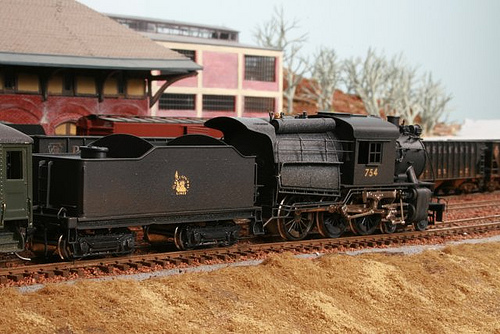
Pride of the steam fleet is a custom-painted and DCC converted Red Ball brass 4-6-0 Camelback. Unfortunately this is currently out of service after overheating while been run on the huge Providence Northern Club layout! The sound-fitted Mikado from Broadway Limited is the current mainstay of the fleet. 0-8-0s are represented by a CNJ-converted Mantua, and a Life-Like Proto 2000 model that is DCC converted but not customized for CNJ yet. Brass and plastic 0-6-0 Camelbacks are available but waiting for DCC conversions.
Passenger coaches are represented by Branchline Model ready to run models (with clerestory) and kits (without clerestory).
Freight cars include ready to run models, shake-the-box kits, and craftsman kits. There is an over-emphasis on CNJ stock that is gradually being addressed.
 Operation
The layout is equipped with DCC from Model Rectifier Corp. This is currently setup as virtually a ‘two-wire’ system, with a single district for the entire layout. In future this will separated into multiple districts to reduce the impact of shorts when running multiple trains. Wireless walk around cabs are essential on a layout of this size.
Automatic turnout control has been provided in Mauch Chunk using a Peco electric pencil, and Peco turnout motors. This system is powered by an ancient British H&M Duet train controller. Future automation will used Tortoise motors and DCC accessory decoders.
The most common means of operating is to run a sequence of trains around the layout in each direction based on a 1948 CRP working timetable with coal trains (which were always ‘extras’) added. When operating to timetable, about 30% of trains use the Nesquehoning yard and don’t run through the White Haven section of the layout.
As an alternative to timetable operation, it is also possible to operate local freights that require switching at each station based on a simple car-card scheme. This may in future be combined with timetable operation if an operating crew is assembled.
At the time of writing, the CRP layout is in storage due to a temporary relocation of Glyn’s job. It is yet to be determined when the line will be reactivated. In the meantime, the photographs give a good idea of the state of the layout.
Glyn Thomas, updated Summer 2012
|